
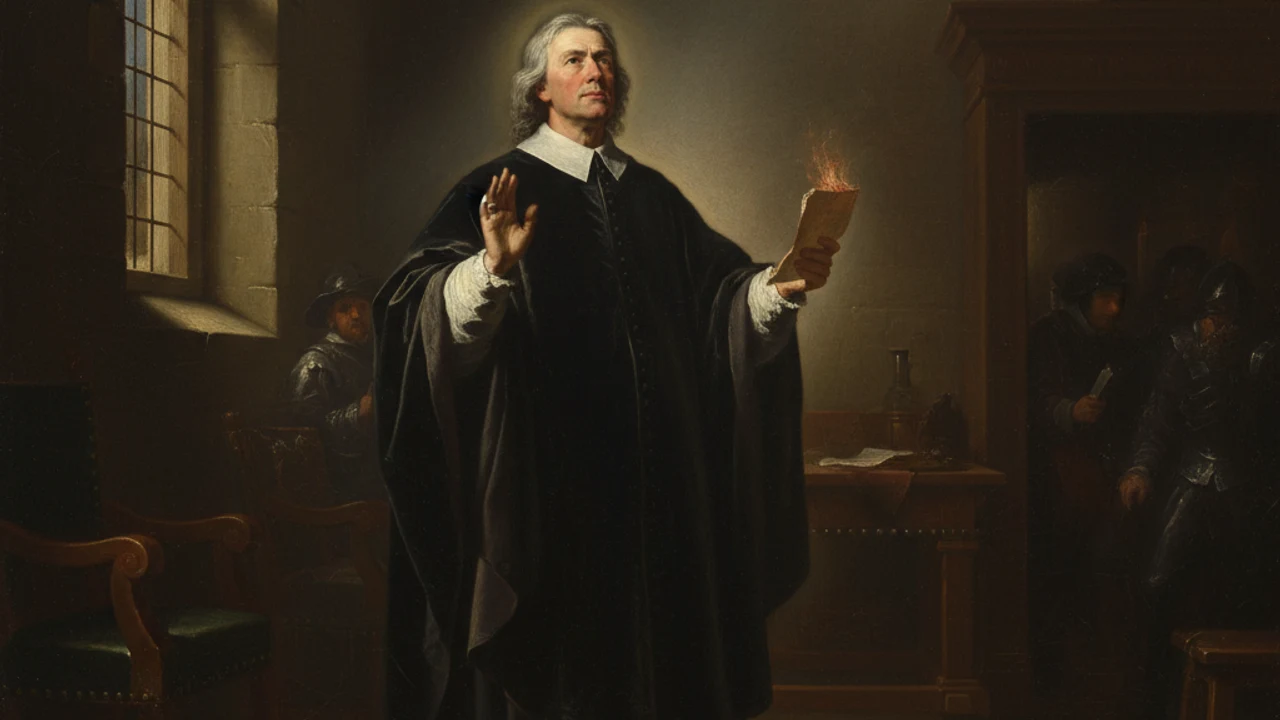
In 1556, Mary and her Roman Catholic allies carried out a plan they had long been preparing. Mary had never forgiven Archbishop Cranmer for his role in her mother’s divorce or for his leadership in the Reformation. Though he had reluctantly supported the cause of Lady Jane Grey—making himself guilty of treason—this alone would likely have been pardoned. But the queen’s hatred and religious zeal were too deep to allow for mercy.
She had long intended to make Cranmer her victim. To satisfy both her own vengeance and the demands of Rome, she chose to prosecute him for heresy rather than treason. Cranmer was summoned by the Pope to appear in Rome and answer charges of heresy. But as he was being held in strict confinement at Oxford, he had no way to respond, even if he had wished to. As a result, the Papal Court condemned him as rebellious for failing to appear.
The queen then sent Bishop Bonner of London and Bishop Thirleby of Ely to Oxford to formally strip Cranmer of his office. The degradation ceremony was carried out with careful detail. Bonner, eager to humiliate Cranmer, went beyond what Thirleby could approve. At the end of it, Cranmer was dressed in a worn-out gown like that of a common countryman and a simple townsman’s cap, and then sent back to prison.
Cranmer was known for his gentle nature, but also for a natural timidity that he often had to fight against. His enemies knew this weakness well and decided to use it to disgrace him. After his trial at Oxford, he remained in close confinement, but was treated with more kindness than at any earlier time in his captivity.
He had longed to die with his friends, Latimer and Ridley, believing their example and company would strengthen and comfort him. But instead, he was forced to witness their martyrdom and left alone. Over time, the sense of abandonment—by both man and possibly even God—began to wear down his inner strength.
His captors noticed this change and planned to use it to make him deny his faith. As Archbishop of Canterbury and spiritual leader of the English Reformation, Cranmer’s recantation would be a powerful blow to Protestant believers. It would not only shame him but could also shake the faith of many others. The priests always intended to kill him, but they wanted him to go to death with the bitter knowledge that he had betrayed his faith for nothing.
They softened him with kind treatment, making him believe they truly wished to help him. In time, they convinced him that the queen and the Church would not only pardon him, but perhaps even restore him to favor—if he would sign a confession denying the truths he had once preached. Overcome by fear, the love of life, and horror at the tortures his friends had endured, Cranmer gave in during a moment of weakness. He signed a statement accepting the pope’s authority and the doctrine of Transubstantiation.
The Romanists, thrilled at their apparent victory, claimed he had surrendered completely. “Most likely,” writes Southey, “he signed an unclear or ambiguous recantation at first, and that the other five documents—where he supposedly endorsed doctrines he had often refuted and called himself a troublemaker and blasphemer—were forged under Bonner’s orders.” The whole situation was filled with doubt and confusion. What is certain is that Cranmer gave in, believing his life would be spared and that he could live quietly, without honor or wealth, wherever he wished.
A month passed after Cranmer’s recantation, during which he was left in uncertainty about his fate—even though it had already been decided. His enemies meant for this time to be filled with humiliation and inner torment, knowing that a man as pure and sensitive as Cranmer would feel deeply the weight of what he had done. And he did suffer—but that suffering, though bitter, brought spiritual healing.
During this time, Cranmer had the chance to reflect on his actions. He saw clearly how much damage his fear and denial could cause the Church. His conscience awakened, and by God's grace, he received the strength that his natural character lacked. His remorse was deep and painful, but it led to repentance rather than despair. Though he was not officially told of the Court’s plans, signs made it clear to him that he would be executed. He resolved to meet death with a courage born of faith.
On March 21, 1556, Cranmer was led out of prison to die. The usual sermon for such occasions was to have been preached at the stake, but because of wind and rain, it was delivered instead at St. Mary’s Church. The authorities fully expected Cranmer to repeat his recantation in front of the crowd, and the sermon was prepared accordingly.
Cranmer stood with solemn dignity. His face and bearing showed the deep sorrow and true repentance that filled his heart. Even his enemies felt pity. John Fox describes the scene: “Cranmer, during the sermon, revealed by his expressions more than words could say. At times he lifted his hands and eyes to heaven, then dropped them to the ground in shame. One could see in him the very image of heartfelt grief. More than twenty times tears streamed from his aged face. Those who were there testified they had never seen even a child weep so bitterly. The sight moved all who looked upon him, for in this old and honored man there was such a sorrowful countenance and such a flood of tears. Yet through it all, he remained calm and noble in his manner.”
Cranmer’s grief was not born of fear for his life, as his steady courage at the end clearly showed. It was the sorrow of deep repentance for denying his faith—a sorrow strong and pure, with no trace of weakness. He had conquered his fears. Had Queen Mary offered him life and freedom that very day in exchange for holding to his recantation, there is no doubt he would have refused, choosing instead to honor his Lord and seal his faith with his blood.
When it was his time to speak, Cranmer rose in the church and declared his submission to the queen and the laws of the land—but only in the sense of accepting whatever punishment they chose to inflict. His greater duty, he said, was to God, and that required him to speak the truth, not to deny the teachings God had entrusted to His Church.
“And now,” he said, “since I am come to the end of my life, upon which depends all that I have done and all that lies ahead—either to live with my Saviour Christ in joy, or to be forever tormented with the wicked in hell—and I see before my eyes either heaven”—and here he pointed upward—“or hell”—and pointed downward—“ready to receive me, I will declare to you my true faith, without disguise or deceit, for this is no time to dissemble.
"I believe in God the Father Almighty, Creator of heaven and earth; and in every part of the true Christian faith; in all that our Savior Jesus Christ taught, and in every word spoken by His apostles and prophets in the Old and New Testaments."
“And now I come to the thing that troubles my conscience more than anything I have ever said or done in my life,” Cranmer continued, “and that is the spreading of writings that went against the truth. I here renounce and reject them—those writings made by my own hand but contrary to what I truly believed in my heart. I wrote them in fear of death, hoping to save my life if it were possible. These include all the papers and statements I have signed since my degradation. In them I wrote many things that were false.
“And because my hand has sinned by writing against my heart, my hand shall be the first to suffer punishment. If I come to the fire, it shall be burned first. As for the Pope, I reject him utterly—as the enemy of Christ and Antichrist—with all his false teachings. And as for the Sacrament, I hold and believe just as I have taught in my book against the Bishop of Winchester.”
The Romanists were enraged by these words. Yet Cranmer’s heartfelt confession, clear and full of conviction, restored his honor in the eyes of many and confirmed his place as a faithful leader in the Reformed Church of England. The priests shouted him down and would not let him speak further. They hurried him away to the stake, where he met death with courage and faith, finishing his life as a true Christian and a steadfast witness for the truth.
Rome’s plan was defeated once again, and the cause of the gospel triumphed in the faith of its martyr. Just as Peter denied his Lord in weakness but later glorified Him in boldness, so Cranmer fell—but rose again, faithful to the end.
The martyrdom of Archbishop Cranmer dealt the greatest blow to the Roman Church of any execution during Mary’s reign. Thousands had witnessed his heartfelt repentance, and no statement from Bonner or the other clergy could convince them otherwise. Tens of thousands saw the calm courage with which he went to the stake. The entire nation grieved his death and was outraged by the cruelty shown to him. Even among those loyal to Rome, the event stirred horror.
Yet Cranmer’s blood only made his persecutors more ruthless. “Cranmer alone so far had been executed after a recantation,” wrote Froude. “To others, pardon had always been offered up to the last moment.” But now, even that small mercy was denied.
From the Cross and Crown, an upcoming audiobook.