
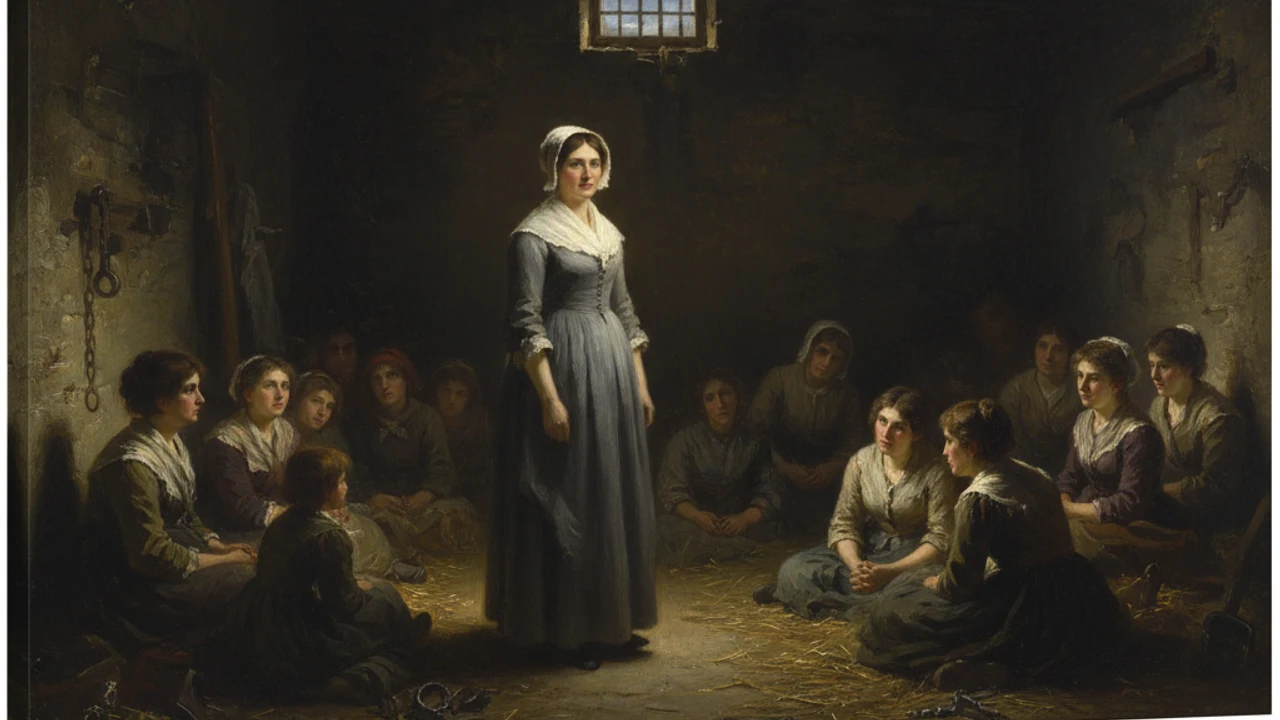
The following is Chapter 10 of Twelve Wonderful Women by E. H. Farrance. Please note that we do not yet have an audiobook of this title on our site. During a visit to London as a young girl, Elizabeth Gurney met an elderly friend, Deborah Darby. Upon seeing the sincere and thoughtful girl, Deborah said she would one day be “a light to the blind, speech to the mute, and feet to the lame.” These words deeply moved Elizabeth and were later fulfilled in remarkable ways. Elizabeth Gurney was born in Norwich on May 21, 1780, one of ten children. Her parents were Quakers. Her father was a banker, known for his broad mind and sharp intellect. Her mother was a well-educated and refined woman, whose death left a deep sorrow in Elizabeth’s early life. At a yearly Quaker meeting, the preaching of William Savery stirred Elizabeth’s heart. She began to grow tired of her life of comfort and fun, and started to long for something deeper. She gave up music, dancing, and outward finery, and chose to wear the plain clothing of strict Quaker tradition. In 1800, Elizabeth married Joseph Fry, a junior partner in a bank. They lived at St. Mildred’s Court in London, which also served as the place of business. Her life quickly became full and busy. The Frys kept an open home for guests. As time went on, children were born. With a large household to manage, guests to care for, frequent letters exchanged with her sisters, and set times of quiet reflection, her days were full. She was appointed by the Quakers to visit the school and workhouse in Islington. Yet, she still felt restless. She longed for a greater field of service, for more direct work among the poor. After Joseph’s father passed away, they moved to the family’s old and lovely home in Plashet, Essex. After the noise and bustle of London, the peace and beauty of the countryside brought her great joy. God was gently guiding His servant, as He always does when His faithful children long to follow His will.  In 1813, at the request of a friend, Elizabeth Fry made her first visit to Newgate Prison, accompanied by the sister of Sir Fowell Buxton. At that time, the condition of prisons was terrible. Everyone was kept together—young and old, criminals, people with mental illness, debtors, and even children. There was hardly any bedding, and no coal or candles were provided. The women were wild and desperate, the air was foul, and the level of misery and sin was beyond description. Alcohol was sold freely to anyone with money. The entire system was full of bribery and corruption, and many of the jailers were no better in character than the prisoners. When Elizabeth and her friend arrived, they found about three hundred women, many with children, crowded into filthy rooms. There was no order or work provided, and they were all under the care of just a man and his son. The women cooked, washed, and slept on the floor. In spite of how dreadful the place was, Elizabeth Fry and her friend went into the cells and spoke kindly to the women. Her compassionate heart was deeply moved, and she longed to do something lasting to help them. The second time Elizabeth Fry visited Newgate, she asked to be left alone with the women, and her request was granted. She read to them, spoke about the love of the Saviour, and then asked for their help in starting a school for the children. She was deeply moved by their response and their clear desire to improve life for their children. For a time, illness and sorrow in her own family kept her from returning, and all she could do was send regular gifts of clothing to the poor prisoners. In 1817, Mrs. Fry resumed her work. The women in the prison welcomed her with tears of joy when she offered to teach their children. They even chose one of their own to lead the school. Elizabeth and a faithful group of helpers gave themselves fully to the work, though the City Magistrates strongly discouraged them. Still, the effort was made, and the results were remarkable: no longer was the prison filled with wild, half-dressed, drunken women demanding charity. Instead, it became quiet—no longer echoing with foul language, curses, or immoral songs. Between 1818 and her final illness in 1841, Elizabeth Fry—except for one occasion—visited every ship that left England carrying women convicts to Botany Bay, seeking to ease their harsh conditions. Her work was praised in both the House of Commons and the House of Lords. It was demanding work, and her daughters often helped her manage the many letters she received from across the country concerning her efforts at Newgate. She also endured much personal hardship and pain in her struggle to bring an end to capital punishment for the crime of forgery. Here is an example of Elizabeth Fry’s remarkable influence. Years later, a woman in Sydney confessed that during one of Mrs. Fry’s talks—what she called a sermon—she had tried not to listen by silently counting to herself. As Mrs. Fry was saying goodbye to the prisoners, she called this young woman aside. Placing her hand on the woman’s shoulder, she said slowly and firmly, “Let not thine eyes covet.” She said nothing more. “Her voice was quiet and solemn; kind like a mother, yet firm like a judge.” When the young woman arrived in the colony, she behaved well for a time. But one day, while looking into her mistress’s box, a gold thimble caught her eye. She slipped it onto her finger at once. Just as she was about to close the lid, she suddenly felt Mrs. Fry’s hand on her shoulder again—the same gentle, firm touch. She looked around in fear, but found herself alone. Overwhelmed, she put the thimble back and trembled with fright. The secret of Mrs. Fry’s influence lay in her deep sense of God’s presence. She often wrote in her journal, “Thou hast been my stronghold, my Rock and my Fortress.” Though she worked tirelessly to improve the prisoners’ outward conditions, she never failed to share with them the message of salvation through the death of the Lord Jesus Christ. A friend who once accompanied Mrs. Fry to Newgate and witnessed her reading the Scriptures to the women wrote this account: “After a few minutes of silent prayer, she quietly opened the Bible and turned to Isaiah chapter 53. Her manner was deeply reverent. She read with such clear, gentle, and well-measured speech that not a word was lost. As she read, her mind seemed fully focused on the passage and nothing else. She spoke with gentle strength about the amazing love of God.” The response from the women was powerful. They deeply loved and respected her. Yet, despite the honor she received, Mrs. Fry remained truly humble, always praying for help and strength. In 1825 and 1826, the Fry family faced serious financial trouble and had to leave their home at Plashet. But the woman who had trusted God in good times now showed she could also trust Him in hardship and accept His will. Her prison reform efforts did not stop with Newgate. They spread to many towns across England and even into Ireland. She felt deeply when some of her children chose to join churches outside the Society of Friends. Yet, with gracious Christian love, she said: “If, after seeking to know God’s will—through His Spirit in your hearts and the teachings of Scripture—you believe you should join another church, then I bid you God-speed in this.” Elizabeth Fry was invited to meet Her Majesty, the young Queen, soon to be married to Prince Albert. She found the Queen to be interested and kind-hearted. Elizabeth continued to travel widely in connection with her work. Later, a season of long and painful illness came. But throughout it all, her faith and trust in God remained firm. Then the call came for this faithful servant, and she “passed away to be with Christ.” Elizabeth Fry was a woman who walked closely with the Lord each day. Because of that, she could hear His voice clearly and fully surrendered herself to His leading.
All Articles
Articles