
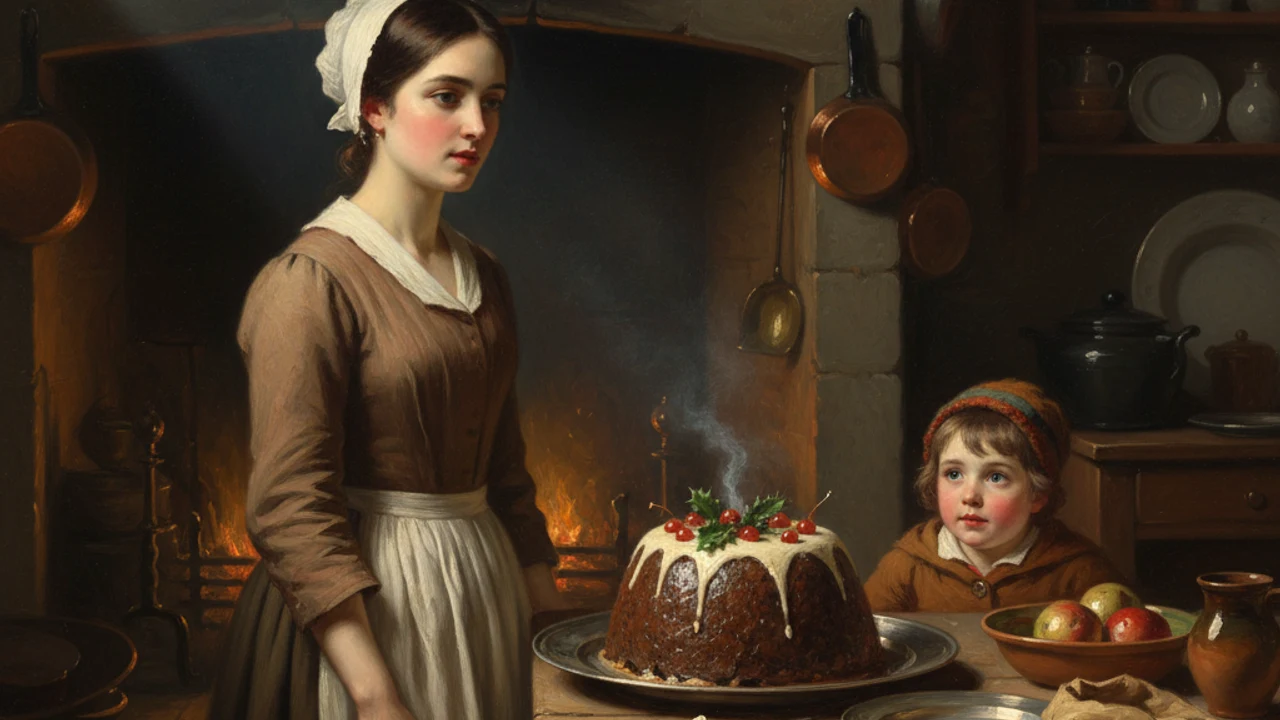
The following story shows how deeply the children absorbed the spirit of faith that filled the home. For them, praying and watching for God’s answer was simply part of life. But not everyone in the house was so easily convinced. Lydia, the servant maid, thought this “faith business” was a poor foundation for managing a household—even though she had to admit there was always food on the table and her wages were never late.
Lydia was fiercely loyal to Miss Soltau, though in a dramatic and emotional way. She longed to give her mistress the kind of luxuries and comforts that clearly weren’t part of God’s plan. One evening, while carrying supper to a sick child, Lydia made her feelings known. The little one had begun chatting cheerfully about Christmas and the wonderful puddings they would soon enjoy.
“There ain’t going to be no pudding,” Lydia said bluntly. “Miss Soltau’s too poor to buy currants and raisins.”
Though startled, the child quickly rallied and caught Lydia off guard.
“Lydia,” she said, “let’s have a secret. When you bring my tray at night, we’ll pray for currants—and see if they come. Don’t let’s tell anyone.”
Lydia eagerly agreed. The idea suited her perfectly—she would be part of a private plan to supply the family’s needs. And if currants did come (and they often did, somehow), she could feel proud of her role in the miracle.
So the two prayed faithfully—but no currants came. As Christmas neared, there was still no sign of an answer.
Then, one night, Miss Soltau returned home near midnight after tending her sick mother. At the door, an excited Lydia met her, breathless.
“Please, ma’am, there’s a parcel come, and I think it’s the currants! The man just put it down and went away.”
Miss Soltau, used to Lydia’s flair for drama, calmed her.
“I’m expecting parcels for China,” she said. “Leave it in the hall and go to bed. You should have been there long ago.”
She went into her study to write some letters. But soon, Lydia appeared again—this time in tears.
“Oh, Miss, please open the parcel. I can’t sleep till I know if it’s the currants.”
Miss Soltau, unaware of the secret prayer pact, was ready to deal firmly with Lydia’s outburst. But amid her sobs, Lydia blurted out the whole story. Together, they opened the parcel—and found twenty pounds of currants. Now both were thrilled. They agreed to say nothing until the children were gathered for evening prayers. Then the bale would be revealed.
The little sick girl, bundled in her dressing gown, was carried downstairs. A cheer of joy filled the room when the children saw the pile of dried fruit. Lydia beamed with pride, knowing she had played a part. Her young prayer partner, with a mixture of awe and certainty, clapped her hands and said:
“You see, Lydia, I knew God would send it.”
After the laughter and thanksgiving, Miss Soltau reminded them gently, “A pudding can’t be made from currants alone.” So together, they prayed—listing before their Heavenly Father the ingredients still missing: flour, sugar, spice, suet, raisins, and more.
The days until Christmas were few. Each afternoon, the children came running in from school asking:
“Has the pudding come yet?”
Just before Christmas, it did. During evening prayers, as Miss Soltau was reading a Psalm, a knock came at the door. Charlie jumped up and said:
“Maybe it’s the pudding!”
Lydia went to open the door and returned dragging a large hamper. Charlie cried out:
“Put away the Bibles—it’s the pudding!”
The room erupted in joyful noise as they opened the basket. Inside was everything needed: flour, sugar, suet, raisins, spices—and even oranges and cakes for everyone. Lydia, now fully convinced, declared herself a firm believer in the power of prayer. From that day forward, she never again doubted the foundation of faith that upheld the household.
There was no clue to the sender. The delivery man simply said:
“There is no name, and no answer.”
There were many times when no clue ever came about who had sent a gift. But in this case, the mystery was solved five months later.
One evening, Miss Soltau was struggling through the dark, fighting a strong southwest wind to reach the pillar-box. There, she saw a woman—frail and elderly—also trying to post a letter. Though Miss Soltau recognized her as someone from Wellington Square, she didn’t know her name. Seeing her struggle against the wind, Miss Soltau offered to walk her home. The woman gratefully accepted.
As they walked, the lady asked, “Aren’t you the one who lives with all the little children?”
“I am,” Miss Soltau replied. “Their parents are missionaries.”
The woman brightened with interest. “Then I should take this chance to apologize for sending a bale of currants without any note. My husband has relatives in Spain who sent him a large shipment of dried fruits last Christmas—far more than we could ever use. We often watch your children running off to school, and I said to him, ‘That’s the kind of household that could use a bale of currants.’ So, we sent them over.”
“You can hardly imagine the joy they brought to my little family,” Miss Soltau said.
The stormy wind interrupted the rest of the conversation, but the woman managed to explain further. After sending the currants, she had felt moved to supply everything else the children would need for a proper Christmas treat—so the second parcel had followed.
“You must forgive me,” she said, “for the way it was done. Not knowing you personally, I wasn’t sure how to send a gift to the children—so I sent it anonymously. But now that we’ve met, I do hope to call on you soon.”
Before they parted, Miss Soltau asked if the children might be allowed to come and thank their kind benefactors in person. The next day, dressed in their best clothes and each having memorized a Scripture verse, the children walked across the square to pay their visit. They were ushered into the room where Mr. Kay, an invalid, lay resting on a sofa.
He listened with deep interest as Miss Soltau shared her side of the story. He was visibly moved by the sight of so many children who, at such little cost to himself, had received such great joy. As he asked about each child’s parents, he heard stories of remarkable devotion and sacrifice for the sake of the Gospel.
Once the ice was broken, the children couldn’t stop talking. They told him about little Emma and her struggle with rheumatic fever, about Lydia’s blunt disbelief, and about the secret prayer for currants—and the surprising answer that had come.
Mr. Kay was shaped by the rationalist thinking of the 19th century, where science was often seen as standing in opposition to belief in divine providence. In those days, the lines were clear—many who rejected Christianity openly called themselves atheists. Mr. Kay had placed himself firmly among the free-thinkers.
Yet now, lying there, he looked at Miss Soltau—her face glowing with a heavenly light—and at the children who so naturally viewed him as a messenger from God. In the background, he pictured their parents, living with courage and faith on the far side of the world.
And in that moment, the walls of unbelief he had built began to collapse. The man who had once said in his heart, “There is no God,” found himself overcome by a Presence he could not deny. For the first time in his life, he bowed inwardly before the God he had long rejected.